
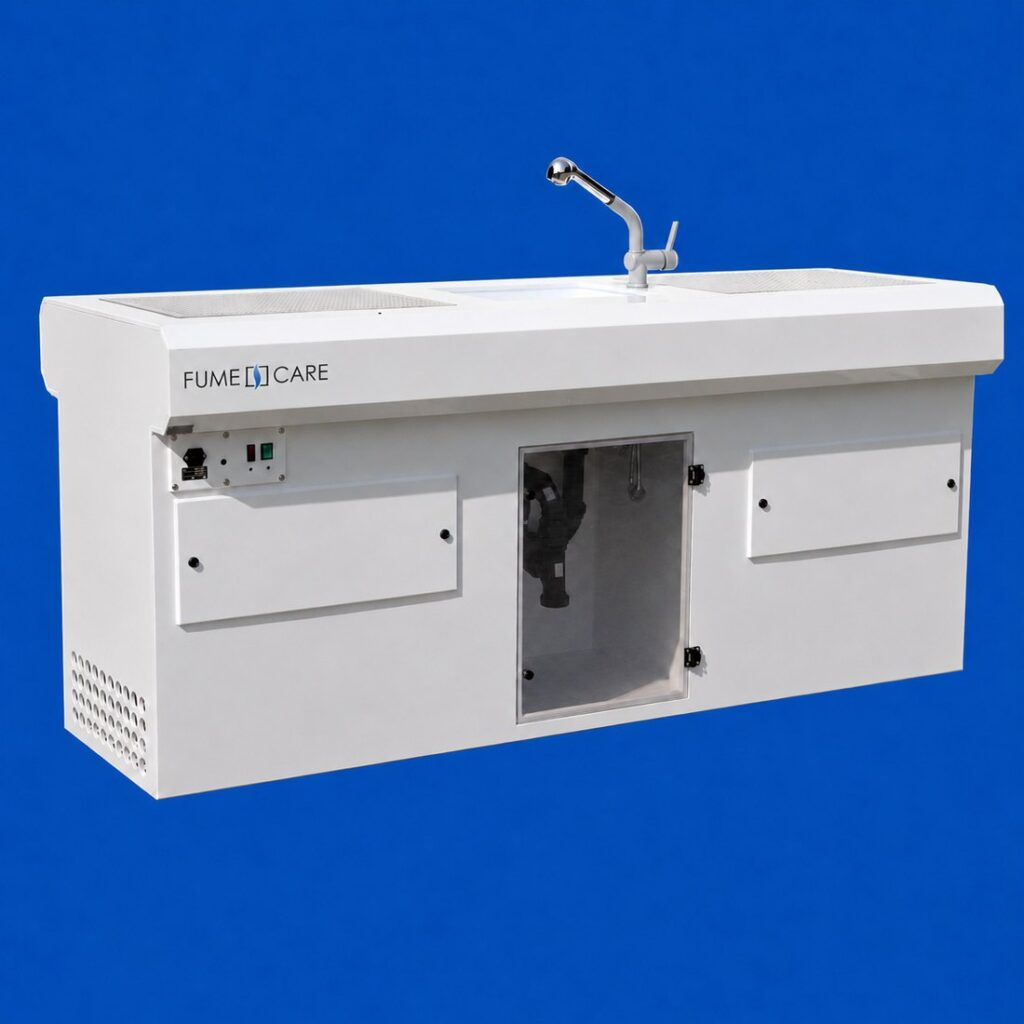
A freestanding downdraft bench that pulls fumes, vapours and dust straight down through the worktop and recirculates filtered air. No ducting, and full open access to the work.
Open-top downdraft protection for work you can't put behind a sash. Document & archive conservation, forensic and evidence handling, histopathology and grossing, powder and solvent tasks, and teaching labs.
Harmful vapours and dust are drawn downward through the perforated stainless steel worksurface by low-noise, speed-controlled centrifugal fans. The air then passes through the main activated carbon filter (and optional HEPA) and clean air is recirculated back into the room.
Because the airflow is downward and recirculating, the operator keeps complete open access to the work. There is no sash, no front barrier and no expensive ducting to install.
Every table ships ready to work, whichever size you choose.
The same downdraft table does very different jobs depending on filter and fit-out. These are the ones we're asked for most.
Gentle, even downdraft for cleaning, treating and de-acidifying documents, maps and books without blowing loose material around. Widely used in archives, libraries and museum conservation studios.
Operator protection during examination, reagent work and sample preparation, with open bench access for laying out and photographing evidence.
Wet service models add a sink and tap, with optional clinical waste disposal that drains fluid waste at the bench. Suited to specimen grossing and formalin work that needs containment plus water.
Downward capture is well suited to weighing and handling fine powders, where a downdraft keeps airborne dust away from the operator's breathing zone.
Activated carbon filtration matched to the solvents in use, with HEPA available where particulate also needs capturing.
A ductless bench that can be sited anywhere with a socket makes downdraft protection practical in classrooms and shared teaching spaces.
The product photo shows a wet service model with a sink and tap. That is a WS model feature, not standard across the range. Here is what each size gives you.
| Model | Width | Typical use | Sink & tap |
|---|---|---|---|
| FDT-100 | 1.0m | Compact benches and single operator work | No |
| FDT-120-WS | 1.2m | General lab use, with room for apparatus | Yes |
| FDT-150-WS | 1.5m | Larger setups and multi user benches | Yes |
| Custom | Bespoke | Built to your size and fit-out | Optional |
WS stands for wet service. All models share the same white polypropylene body with a perforated stainless steel worktop, low airflow alarm and single phase supply. Custom sizes and fit-outs can be built to order. Full dimensions and datasheet available on request.
Each FDT takes a main filter and a matching safety filter chosen for what you're working with. Tell us the substances and we'll specify the right media.
Fumes and dust are drawn down through the worktop, filtered, and clean air is returned to the room. No ducting to install and no loss of conditioned air.
The white polypropylene body resists acids and aggressive chemistry that would corrode steel, and it wipes down easily. A strong choice for reagent and solvent work.
Fitted as standard on every model. It alerts the operator if worksurface face velocity falls below 0.3 m/sec, so protection is never left to chance.
No sash and no front barrier. The operator keeps full open access to lay out, examine and photograph work while staying protected from below.
Runs on a standard single phase supply and can be sited anywhere with a socket, so downdraft protection is practical in almost any room.
All operation and maintenance is carried out from the front, so filter changes are simple and the unit can sit against a wall.
Send us the model and what you'll be working with and we'll come back with a filter specification and price, typically within four working hours.