NIN-PRO Fingerprint Development Chamber
Forensic Fingerprint Development

NIN-PRO Fingerprint Development Chamber

Develop treated prints on paper and porous evidence under precisely controlled temperature and humidity. The NIN-PRO turns ninhydrin, DFO and indandione reactions that used to take days into a fast, repeatable, documented cycle.

Develops
NIN, DFO & indandione
Surfaces
Paper & porous evidence
Control
Temperature & humidity, touchscreen
Sizes
0.66m / 0.9m / Custom

Latent print development on porous evidence. Fingerprint bureaux, accredited forensic laboratories, questioned document units, evidence recovery, and forensic teaching and training.

Fingerprint bureaux Forensic labs Questioned documents Evidence units Training
Why control matters

The development step decides the result, not the chemistry alone

Prints on paper and card are found by treating the evidence with ninhydrin, DFO or indandione, dipped or sprayed, and then developing it under heat and humidity. Get those conditions right and prints come up quickly with strong contrast. Get them wrong and the reaction is weak, uneven, or takes days.

Many labs still do that step in whatever is to hand: an oven, an incubator, or a vented cabinet built for something else. The NIN-PRO is a purpose-built forensic climate chamber. It holds temperature and humidity to setpoint, runs the same cycle every time, and records what it did against the case.

  • ✓Purpose-built for ninhydrin, DFO and indandione, not a repurposed oven
  • ✓Precise, monitored temperature and relative humidity control
  • ✓Repeatable cycles for results that compare between operators and days
  • ✓Ductless and recirculating, ready to use with no ducting required

Standard on every NIN-PRO

The full control and recording system on every chamber.

Touchscreen controlTemperature controlHumidity controlStandard & user cyclesKey-lock doorAirflow alarm
Precise climate

Two conditions, held exactly, for as long as it takes

Ninhydrin, DFO and indandione each want their own temperature and humidity to develop cleanly. The NIN-PRO holds both to setpoint and keeps them there through the whole contact time.

Temperature to setpoint

A heater under PID control brings the chamber to the set temperature and holds it steadily, with an auto-tune routine to keep the plate accurate. Steady heat means the reaction develops evenly across the exhibit rather than in patches.

Humidity to setpoint

An onboard humidifier brings relative humidity up to the level the developer needs and holds it there, monitored throughout. The sensors can be calibrated on screen against a certified RH meter, with the offset stored.

Both conditions are shown live on the touchscreen throughout the cycle, and the operator can end the contact time early once the prints are clearly developed, with the choice recorded.
Developer versatility

Built for the three, open to more

The NIN-PRO is set up for the three related processes used most on porous surfaces, but it is not limited to them. Because it gives you control over the conditions rather than a fixed recipe, it can be used with other chemical developers too, and DFO and indandione prints go on to fluoresce under lasers and forensic light sources for examination.

  • ✓Standard cycles plus user-defined programmes you can save
  • ✓Works with other developers by setting your own temperature and humidity
  • ✓DFO and indandione results fluoresce under laser and light-source examination
NIN
Ninhydrin
DFO
Diazafluorenone
IND
Indandione
Other
User-set conditions
Evidence integrity

A development step you can account for

In forensic work it is not enough that the print came up. You need to be able to show the conditions it was developed under, who ran it, and that the equipment was in calibration at the time.

Case & officer capture

Security tag and user or case details are entered on screen and written into the record for the run, so the development step is tied to the exhibit and the operator.

Data logging

A USB data port records the cycle, and an Ethernet port is fitted for remote monitoring, so the parameters a print was developed under can be produced for the file.

Calibration you can evidence

The humidity sensors are calibrated on screen against a traceable certified meter, so you can demonstrate the chamber was in calibration when the exhibit was processed.

Secure, key-locked door

Security tags and a key lock on the main access door keep custody of the exhibit intact through the development step.

On-screen help & diagnostics

A question mark on any screen explains that function, cutting training time, and a diagnostics screen shows what is running and flags anything, such as a low humidifier water level, that is not.

Cancel with a record

If the prints are clearly developed, the operator can end contact early. The system asks for confirmation and records whether the cycle completed or was ended by the operator before it purges.

Contamination control

Clean between developers, clean between cases

Developing porous evidence throws off chemical dust, and that dust can carry material, including DNA, from one exhibit to the next. The NIN-PRO is filtered and built to be cleaned properly, and the chamber can be decontaminated between cases.

  • ✓Filtered airflow with a prefilter, keeping chemical dust out of the airstream
  • ✓Airflow alarm that warns of a blocked or spent filter
  • ✓Ductless recirculating design, so vapours are filtered before air returns to the room
  • ✓Optional UV decontamination lights with a door interlock for a further clean between cases

Ready to run

Supplied set up for work, with the loose items fitted in minutes.

HumidifierTraysShelf brackets & barsPrefilterKeysManual & stylus
Where it's used

For prints on the surfaces superglue can't reach

Cyanoacrylate develops prints on non-porous items. Ninhydrin, DFO and indandione develop them on porous ones, and this is the chamber that gets the conditions right.

Paper, card & documents

Letters, notes, packaging, currency and questioned documents, the porous items where amino-acid reagents like ninhydrin, DFO and indandione do their work.

Fingerprint bureaux

Routine, high-volume development of treated porous exhibits, with a repeatable cycle that gives comparable results between operators and between shifts.

Accredited laboratories

Where the development conditions and calibration have to be defined, traceable and demonstrable as part of a quality system and accreditation.

Questioned document units

Development of prints on documents and paper exhibits where the item itself is the evidence and must not be damaged in the process.

Fluorescence workflows

Where DFO or indandione is chosen so the developed prints fluoresce, the chamber develops the reaction ready for examination under laser and forensic light sources.

Training & teaching

Forensic courses and in-force training benefit from a chamber that shows each parameter on screen, so trainees can see how conditions shape the result.

Configurations

Two sizes, plus custom

Choose the chamber to suit the exhibits you handle and the space you have. Both share the same control, humidity and heating system.

ModelWidthFormatTypical use
NIN-PRO-600.66mBenchtopSmaller exhibits and limited bench space
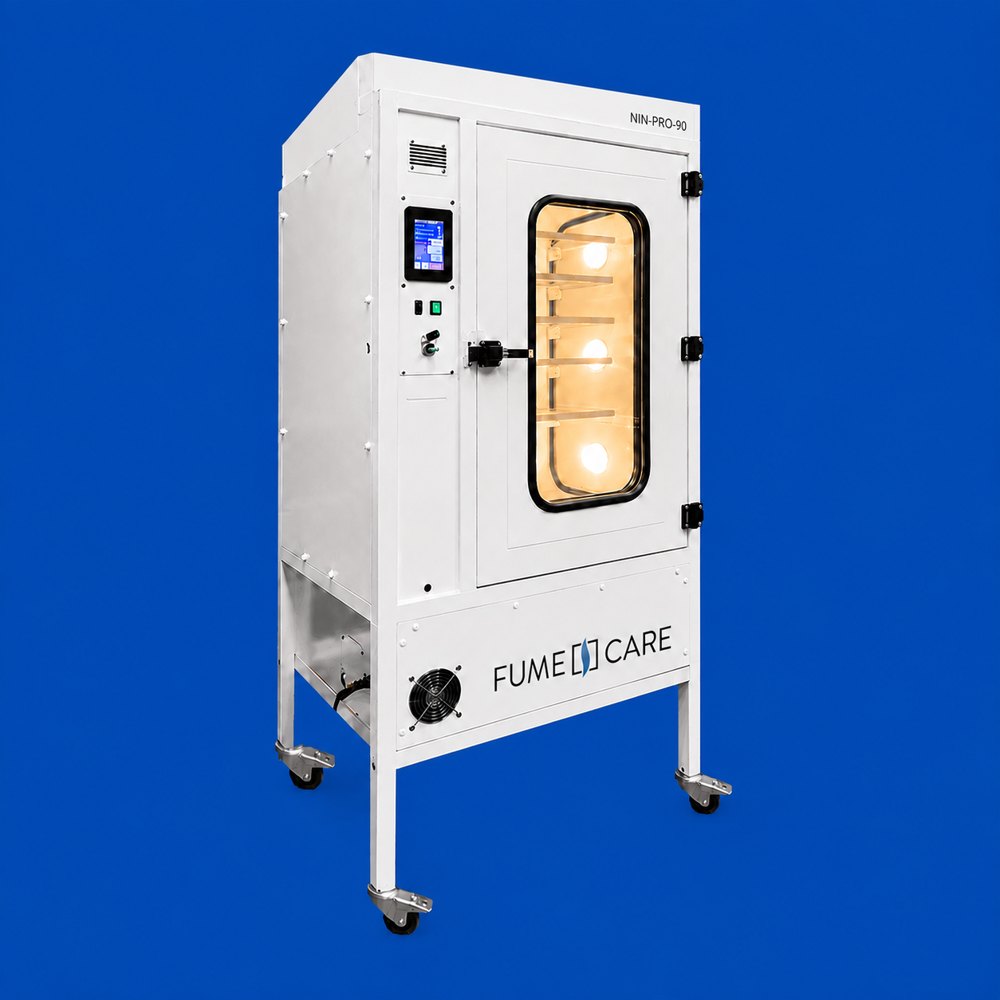
NIN-PRO-900.9mOn mobile standGeneral casework, the popular size
CustomBespokeTo suitBuilt to your size and requirements

Both models share the same touchscreen control, temperature and humidity control, standard and user-defined cycles, key-lock door, airflow alarm and data logging. Supplied with humidifier, trays, shelf brackets and bars, prefilter, keys, manual and stylus. The humidifier is filled with around 6.5 litres of deionised or distilled water. Full dimensions and datasheet available on request.

Filtration

Filtered, recirculating, no ducting

The chamber uses carbon and HEPA filtration with a prefilter, capturing the vapours, odours and chemical dust that come off treated evidence so nothing hazardous is released into the room. Its recirculating design means it is ready to use with no ducting to install.

Prefilter Carbon HEPA Airflow alarm No ducting required
Ready to use
Recirculating design, so the chamber is ready to run with no ducting to install
Key features

Built for casework, day in and day out

PLC touchscreen control

A colour touchscreen with 24Vdc digital input and analogue output sets every parameter, keeps the operator informed of each stage, and stores standard and user cycles.

PID temperature control

Heater temperature is held under PID control with an auto-tune routine, for steady, even development across the exhibit.

Humidity control & calibration

An onboard humidifier holds relative humidity to setpoint, and the sensors calibrate on screen against a certified meter with the offset stored.

Airflow alarm

The system alerts the operator to a blocked or spent filter, so a cycle is never run on compromised airflow.

USB & Ethernet

A USB port records cycle data and an Ethernet port allows remote monitoring, ready for the case file or wider systems.

Adjustable shelving

Shelf brackets, bars and trays position exhibits inside the illuminated chamber to suit whatever the case brings in.

Optional UV decontamination

Internal sockets are built in for UV lamps, giving a further decontamination step between cases, timed from the screen with a door interlock.

Ductless and mobile

Recirculating design means no ducting to install, and lockable castors let the chamber be positioned and moved as the unit changes.

Made in the United Kingdom

Designed and manufactured in our ISO 9001:2015 accredited facility, with the documentation and traceability that brings.

Get a quote

Tell us the size and how you work

Send us the model you need and a little about your casework, and we'll come back with a specification and price, typically within four working hours.

Your requirements

Accessories

Contact details

Or email us directly at office@fumecare.com