
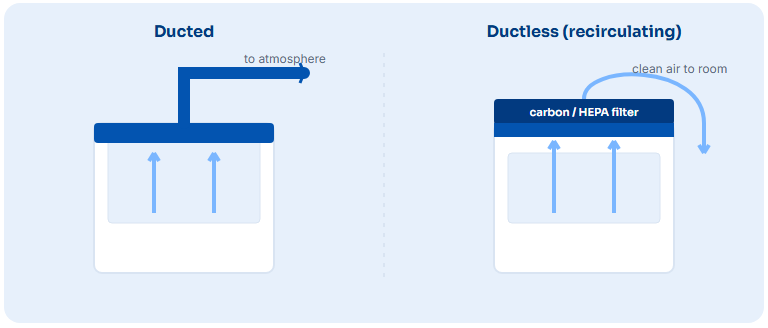
If you have ever stood in a lab and wondered why one fume cupboard has a pipe running up through the ceiling and another simply plugs into a socket, you have already spotted the main difference. The two designs solve the same problem, protecting the person at the bench from harmful fumes, but they go about it in very different ways.
Neither one is better in every situation. The right choice depends on what you are working with, how much of it, the building you are in, and how much flexibility you need. Let us walk through it.
How a ducted fume cupboard works
A ducted, or extract, fume cupboard draws air across the working area, away from the operator, and pushes it out of the building through ductwork and usually a roof-mounted fan. The fumes leave with the air. Fresh air is drawn in to replace what is lost.
Because the contaminated air is removed entirely, a ducted system can handle a very wide range of substances, including large quantities and aggressive chemistries that a filter would struggle with. That is its great strength.
The trade-offs are practical ones. Ductwork has to be designed, installed and routed to the outside, which is not always possible in a listed building, a rented space or an upper floor. Ducted systems also pull conditioned air out of the room continuously, so there is an ongoing energy cost to heating or cooling the replacement air.
How a ductless fume cupboard works
A ductless, or recirculating, fume cupboard does not send anything outside. Instead it draws the air through filters, typically a prefilter followed by activated carbon for vapours, or a HEPA filter for particulates, and returns the cleaned air back into the room.
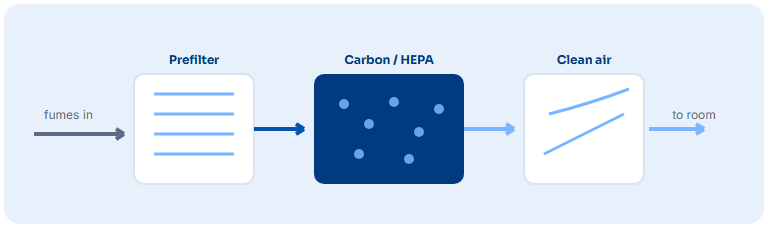
The appeal is obvious. There is no ductwork to install, so a ductless unit can go almost anywhere there is a socket, and it can be moved when the lab changes. It does not throw away heated or cooled air, which keeps running costs down. For many labs it is quicker, cheaper and far more flexible to put in place.
The important caveat is that a filter has a finite capacity, and no single filter suits every chemical. The media has to be matched to what you use, and it needs replacing before it becomes saturated. Ductless cupboards are best suited to lower-volume work with substances the filter can genuinely hold.
The honest way to choose is not “which is better?” but “which suits the work I actually do, in the space I actually have?”
Putting them side by side
| Consideration | Ducted | Ductless |
|---|---|---|
| Range of chemistry | Very broad, including large volumes | Best for lower volumes the filter can hold |
| Installation | Needs ductwork to the outside | Plug in and use, no ducting |
| Flexibility to move | Fixed once installed | Easily repositioned |
| Energy | Loses heated or cooled air continuously | Recirculates, so lower running cost |
| Ongoing consumables | Minimal | Filters need replacing over time |
| Best suited to | High-volume or aggressive work | Teaching, QC, forensic and lighter tasks |
Quick way to decide
- Working with large volumes, boiling off solvents, or aggressive acids? A ducted system is usually the safer answer.
- In a building where ducting is difficult, or you need to move the unit around? A ductless cupboard makes life much easier.
- Handling modest quantities of substances a filter can hold, such as teaching, quality control or forensic work? Ductless is often ideal.
- Still unsure? Tell us the substances and volumes and we will help you weigh it up honestly.
Where ductless reaches its limit
It is worth being clear about this, because it matters for safety. Filtration is not the right answer where very large quantities of contaminant are produced, such as acid digestion or evaporating solvents to dryness, nor for very highly toxic substances or reactions whose products are unknown. In those cases a ducted system, or a different control altogether, is the sensible route. A good supplier will tell you when a ductless unit is not appropriate rather than sell you one anyway.
A note on filters
If you do go ductless, the filter is doing the safety-critical work, so it pays to get the grade right. Activated carbon handles solvents and organic vapours well, but low-molecular-weight gases such as ammonia and formaldehyde need carbon that has been treated to react with them. Particulates need HEPA. We cover this in detail in our guide to choosing the right filter.
Fumecare ductless fume cupboards
Recirculating cupboards and workstations built in the UK, with the filter matched to your work.