
A bloodstained garment recovered from a scene arrives wet. What happens next matters enormously, and often it has to happen quickly. Left damp, that exhibit is not simply waiting patiently in a bag. It is changing.
Why wet evidence is on a clock
Biological material does not keep well when it is wet. Bacteria and mould set to work, and the very material that carries a DNA profile can degrade. Seal a wet exhibit in a bag and you create warm, damp conditions that make things worse, not better. A profile that could have identified someone can be weakened or lost, sometimes within hours.
So drying is not a housekeeping step. It is evidence preservation, and doing it promptly and properly protects the case.
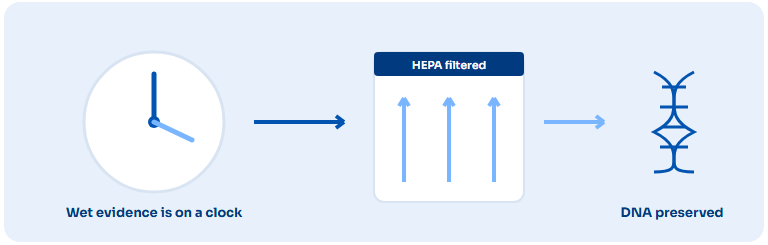
Sealing a wet exhibit in a bag does not pause the problem. It accelerates it. Drying, done properly, is what preserves the evidence.
Why not just hang it up to dry?
The obvious idea, drying an exhibit in the open or in a general fume hood, brings its own problem, and it is a serious one. Modern DNA profiling is extraordinarily sensitive. It can pick up tiny amounts of transferred material. That sensitivity is a strength, but it also means anything sharing the air with your exhibit becomes a potential source of contamination, and a question a defence lawyer can raise.
Open drying exposes the exhibit to whatever is in the room, and risks material from one item settling on another. For evidence that may end up in court, that is a risk worth designing out.
What a proper drying cabinet does differently
A forensic evidence drying cabinet is built to solve both halves of the problem at once: dry the exhibit quickly, and keep it clean while you do. The key ideas are:
- Filtered air. Air passed over the exhibit is filtered, so the exhibit dries in clean conditions rather than room air.
- Containment. The exhibit dries inside a closed, controlled space, not out in the open where cross-contamination can occur.
- Contained exhaust. Odours and particulates given off by the drying exhibit are filtered before anything returns to the room.
- A clean break between exhibits. The cabinet is cleaned between cases, and good systems make that step deliberate and recorded rather than assumed.
Recover wet
Exhibit arrives damp and biological material is already at risk.
Dry clean
Dried quickly inside a closed, filtered cabinet, away from room air.
Preserve
A viable profile is protected, and the chain of custody supported.
Why it matters for the case
- Prompt drying protects a DNA profile that damp would degrade.
- Filtered, contained drying reduces the risk of cross-contamination.
- A clean break between exhibits keeps one case from affecting another.
- A record of how and when an exhibit was dried supports the chain of custody.
The chain of custody
The integrity of evidence is often challenged on process, not just findings. Being able to show that an exhibit was dried promptly, in clean and contained conditions, with the cabinet cleaned beforehand and the step recorded against the case and officer, is exactly the kind of documentation that stands up to scrutiny. It turns a vulnerable moment in the evidence's journey into a well-controlled one.
The FDC-PRO forensic evidence drying cabinet
Dries exhibits under clean, filtered air in a contained cabinet, with an enforced clean break and a record for the case file.