
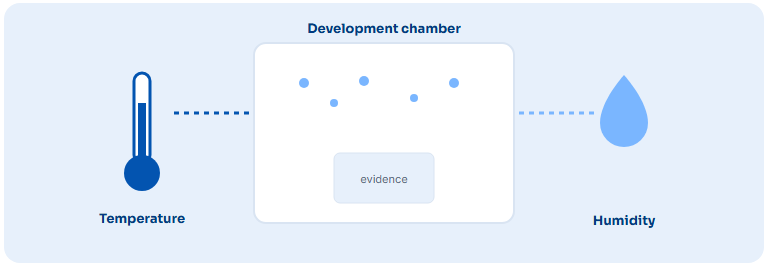
Ask an experienced fingerprint examiner what separates a good development result from a poor one, and humidity will come up quickly. It is not the most glamorous variable, and it is invisible, but it sits at the heart of why some prints emerge crisp and complete while others come up faint, patchy, or buried under over-development.
Understanding why helps explain why a proper chamber is worth having, and why an improvised setup so often disappoints.
A fingerprint is mostly water
The residue that makes up a latent print is largely moisture, along with oils, salts and amino acids. Many of the reactions used to reveal that residue depend directly on the water content of the print and the moisture in the surrounding air. Change the humidity and you change the chemistry.
In superglue fuming
Cyanoacrylate vapour reacts with the moisture in a print to build the white polymer along the ridges. If the air is too dry, the reaction is slow and the deposit is thin and faint. If it is too humid, or the humidity is uneven, the polymer can grow too fast and too thick, blooming over the fine detail and losing the very ridges you needed.
In porous-surface development
Reagents such as ninhydrin and DFO also depend on moisture to react with the amino acids in the print. The right humidity helps the reaction proceed evenly and fully. Too little, and development is weak and slow; the wrong conditions can also affect the background and the item itself.
Humidity is the difference between a print you can identify and one you have lost. It is too important to leave to the weather in the room.
Why steadiness matters as much as level
It is not enough to reach the right humidity for a moment. The reaction needs those conditions held steadily for the whole development time. A setup that drifts, or that only reaches the target briefly, gives uneven results across the exhibit, one area well developed and another barely touched.
This is the real advantage of a purpose-built chamber. It brings the environment to the right point and holds it there, so the reaction proceeds the same way across the whole item, every time.
What good humidity control gives you
- Clean, sharp prints with the fine ridge detail intact.
- Even development across the whole exhibit, not just part of it.
- Repeatable results you can compare between operators and cases.
- Less risk of over-development ruining a print you cannot recover.
- A recorded set of conditions that supports the integrity of your work.
Calibration keeps it honest
A humidity reading is only useful if it is accurate. This is why good chambers allow the humidity sensor to be calibrated against a certified meter, so the value on the screen reflects reality. An instrument that has drifted out of calibration can hold a number that looks right while the true conditions are wrong, which is exactly the situation you want to avoid in casework.
The documentation angle
Finally, controlling humidity is not only about the print in front of you. Being able to record and show the conditions an exhibit was developed under, alongside the case and the operator, supports the integrity of the evidence. If the process is ever questioned, having that record is far better than relying on memory.
CA-PRO and NIN-PRO development chambers
Precise, monitored and recorded temperature and humidity for both superglue fuming and porous-surface reagents.