
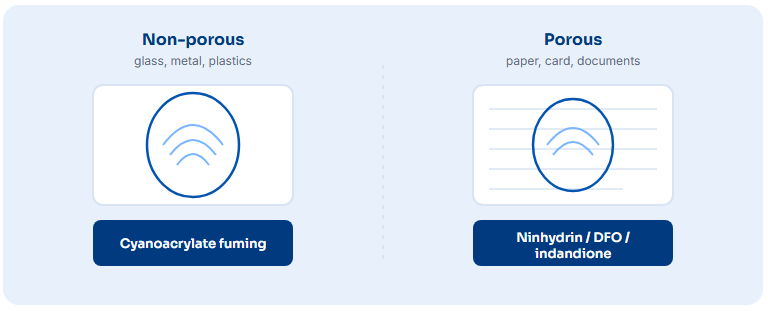
If cyanoacrylate is the answer for glass and metal, what about the letter, the banknote or the cardboard box? Porous surfaces are a different problem entirely. The fingerprint residue soaks into the material rather than sitting on top of it, so surface fuming has little to grip. Instead, examiners turn to a family of chemical reagents that seek out the amino acids in the print.
Reacting with what the finger leaves behind
Sweat contains amino acids, and these soak into porous materials along with the rest of the print residue. Ninhydrin, DFO and indandione each react with those amino acids to make the print visible, but they do so in slightly different ways, which is exactly why examiners value having all three available.
- Ninhydrin is the long-standing workhorse. It reacts with amino acids to produce a distinctive purple colour, giving a print you can see directly under normal light.
- DFO tends to be more sensitive and produces prints that fluoresce under a forensic light source, so it can reveal detail ninhydrin might miss. It is often used first in the sequence.
- Indandione is another amino-acid reagent valued for strong fluorescence, and is sometimes used in place of or alongside the others.
These reagents are not rivals. Used in the right order they complement each other, and one can reveal prints the others leave hidden.
The role of heat and humidity
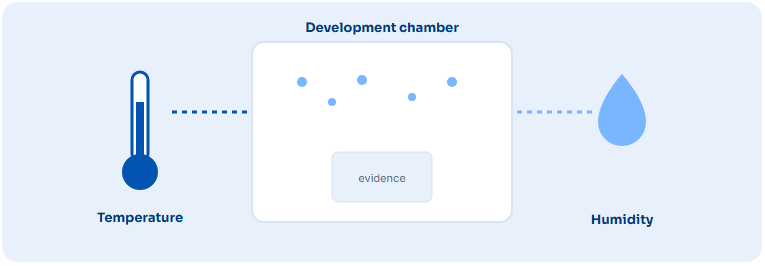
Here is the part that is easy to underestimate. Once the evidence has been treated with the reagent, the reaction that actually brings the print up needs the right conditions to proceed cleanly. Left to develop slowly in the open, some of these reactions can take a very long time and give uneven results. Applied with careless heat, such as a household iron, they can scorch or discolour the very document you are trying to preserve.
A controlled chamber holds the temperature and humidity the reagent needs, steadily, for a set time. The reaction that might otherwise crawl along for days can be brought up in minutes, evenly across the exhibit, without risking the item itself.
Working with fluorescence
Because DFO and indandione prints fluoresce, they are examined under lasers or forensic light sources rather than plain light. A good workflow develops the reaction properly first, so that when the examiner reaches for the light source, the detail is there to see and photograph.
Handling the evidence with care
Developing porous evidence can throw off chemical dust, and that dust may carry material, including DNA, from one item to the next. So alongside getting the chemistry and conditions right, keeping the process clean and contained matters just as much. We look at that in our guide to preventing cross-contamination.
The NIN-PRO fingerprint development chamber
Precise, monitored temperature and humidity for ninhydrin, DFO and indandione, with standard and user-defined programmes.